
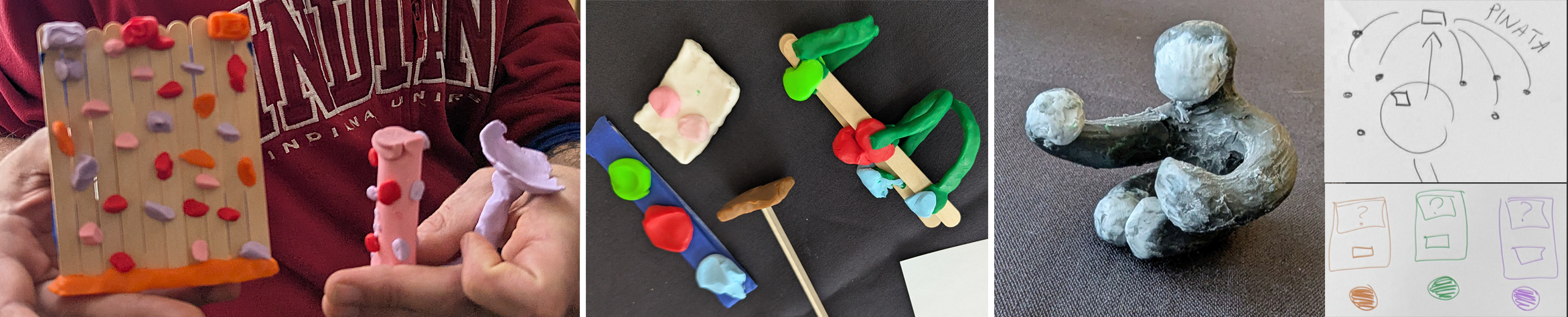
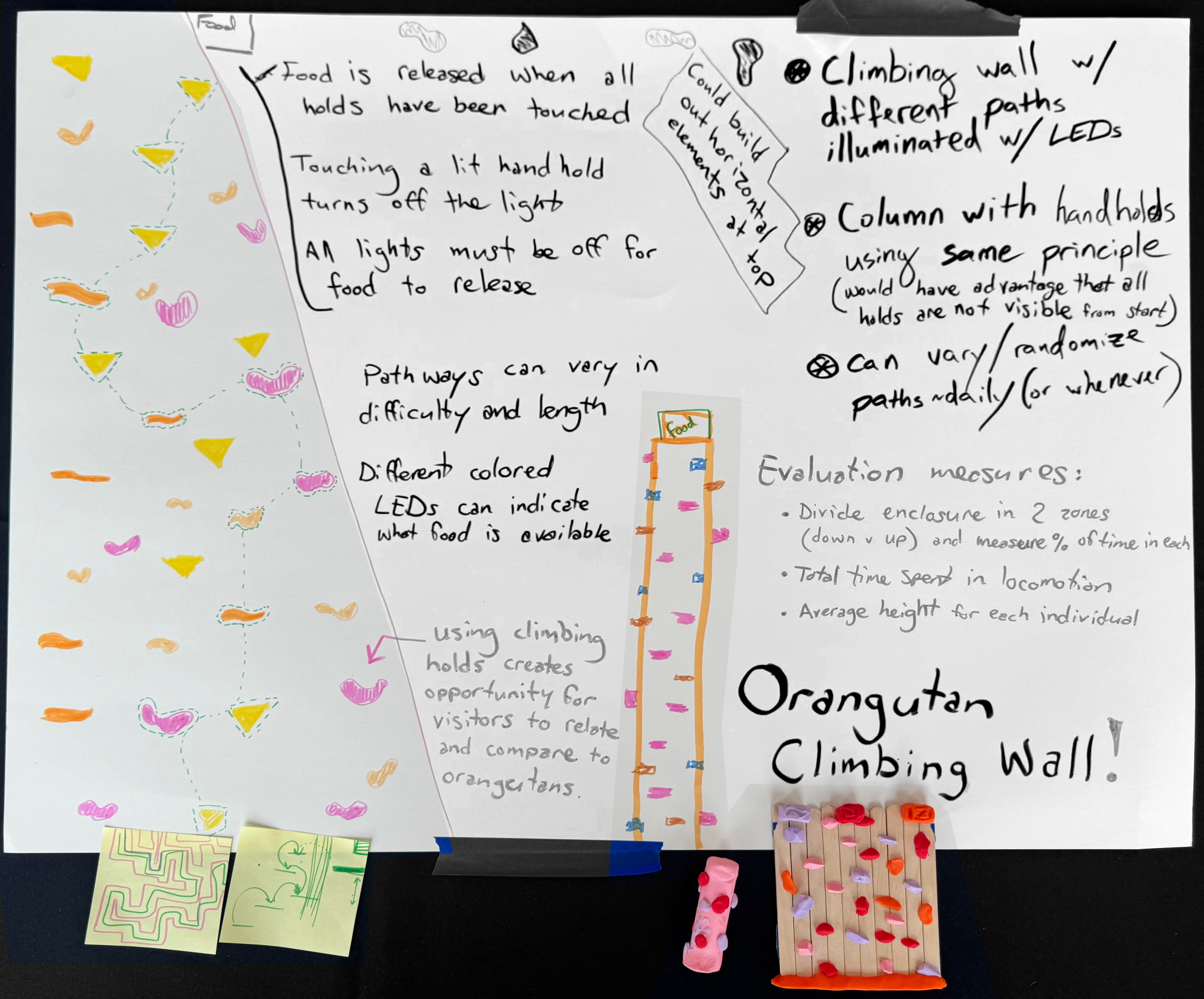
Throughout the main enclosure, and perhaps on new columnar structures in the center of the main enclosure area, install climbing wall handholds that create trails to feeding boxes which are located near the ceiling. Each day, sub-sets of handholds would be illuminated (either internally with LEDs and translucent handholds, or externally using projection) with colors that match one of the feeder boxes, each with different, high-value food items.
For example, suppose there are 3 feeder boxes and 150 handholds installed around the enclosure. On day 1, one box is red, another is pink, and a third is yellow. A "trail" of ~30 handholds leading to each box would be illuminated in the same colors. In order to unlock the pink feeder box, the orangutans have to have used each of the 30 pink handholds (in any order), which would be assessed and validated with a computer vision system. Similar trails would be illuminated red and yellow that same day. On day 2, new sub-sets of handholds would be randomized in colors matching the three boxes; and so on. The symbols used by Dr. Rob with his touchscreen tasks could be incorporated into the system as well for the orangs who have learned them.
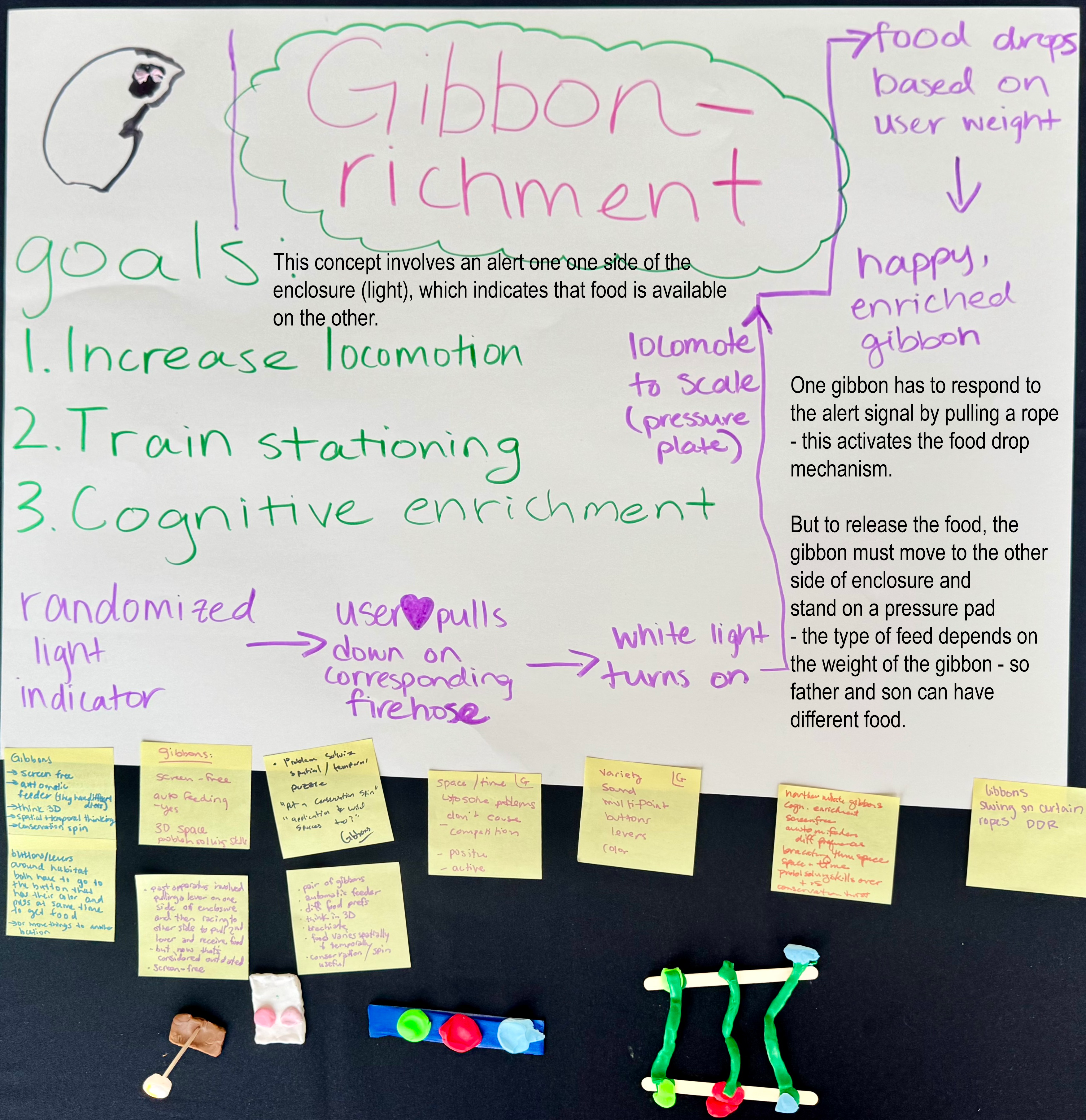
There could be confusion over which gibbon is being enriched, and why the food isn't released if the 'wrong' animal stands on the pad. To avoid this, there could be 2 feeding stations, perhaps in different locations, one for father and one for son, and 2 corresponding light signals. Would the gibbons understand the connections and only respond to the signal directed towards them specifically? Alternatively, they could be fed simultaneously, but from different food-drop sources, and if dad is busy standing on his pad, son will be free to stand on his own one without anyone trying to take his food...
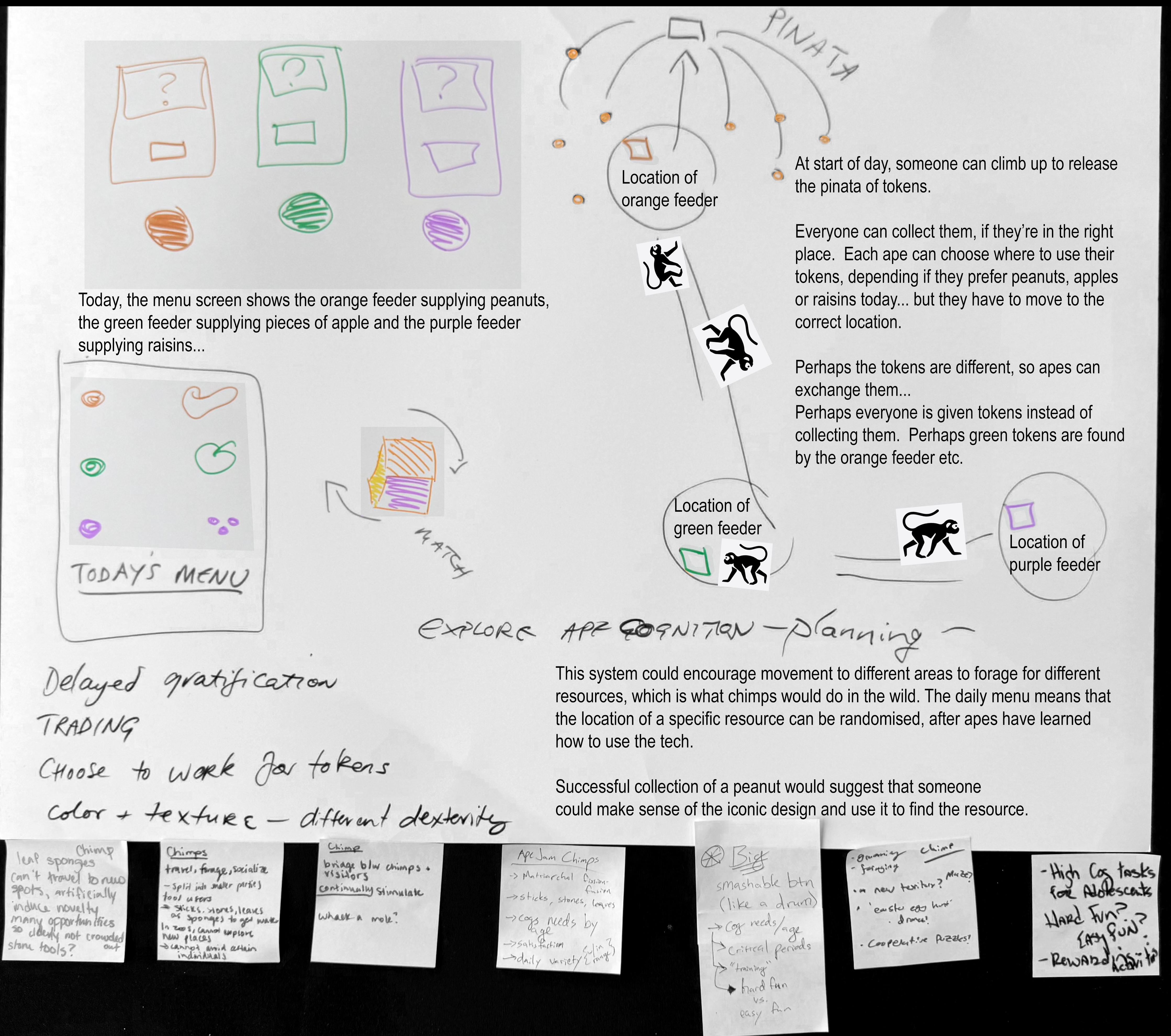
Instead of tokens and slot machines distributing treats, useful tools (sticks, sponges, rocks etc) could be menu items that are found in specific locations. Resources such as water should be available in at least 2 different places, so everyone has a chance to collect and no-one can dominate 2 places at once. Ideally, the route between interesting locations (for tools or food) should be ci rcular, so it's possible to avoid other individuals and never be trapped in one place. Staff should be able to block parts of the route if they need everyone to come indoors at night.
The bridge between chimps and visitors could take the form of a parallel route for humans, who might like to test their reaction time and speed against chimp reaction time and speed (menu screen lights up - banana drop HERE!)...